|
Engineering and Project Development Services Absorption Chillers * Adsorption Chillers * Ammonia Chillers * Brayton Cycle * Carbon Emissions Carnot Cycle * Cheng Cycle * CHP Systems * Clean Power Generation * Cogeneration Compressed Air Energy Storage * Concentrating Solar Power * EcoGeneration * Emissions Abatement Engine Driven Chillers * Graz Cycle * Inlet Cooling * Mechanical Refrigeration * Organic Rankine Cycle Rankine Cycle * Recycled Energy * Solar Cogeneration * Trigeneration * Waste Heat Recovery
|
Absorption Chillers
www.AbsorptionChillers.com
Absorption Chillers & Adsorption Chillers
For Cogeneration,
Trigeneration
Demand
Side Management, Solar
Trigeneration & Waste
Heat Recovery Applications
Absorption
chillers use heat instead of mechanical energy to provide cooling. A
thermal compressor consists of an absorber, a generator, a pump, and a
throttling device, and replaces the mechanical vapor compressor.
In
the chiller, refrigerant vapor from the evaporator is absorbed by a
solution mixture in the absorber. This solution is then pumped to the
generator. There the refrigerant re-vaporizes using a waste steam heat
source. The refrigerant-depleted solution then returns to the absorber via
a throttling device. The two most common refrigerant/ absorbent mixtures
used in absorption chillers are water/lithium bromide and ammonia/water.
Compared with mechanical chillers, absorption chillers have a low coefficient of performance (COP = chiller load/heat input). However, absorption chillers can substantially reduce operating costs because they are powered by low-grade waste heat. Vapor compression chillers, by contrast, must be motor- or engine-driven.
Low-pressure, steam-driven absorption chillers are available in capacities ranging from 100 to 1,500 tons. Absorption chillers come in two commercially available designs: single-effect and double-effect. Single-effect machines provide a thermal COP of 0.7 and require about 18 pounds of 15-pound-per-square-inch-gauge (psig) steam per ton-hour of cooling.
Double-effect machines are about 40% more efficient, but require a higher
grade of thermal input, using about 10 pounds of 100- to 150-psig steam
per ton-hour.
A
single-effect absorption machine means all condensing heat cools and
condenses in the condenser. From there it is released to the cooling
water. A double-effect machine adopts a higher heat efficiency of
condensation and divides the generator into a high-temperature and a
low-temperature generator.
_______________________________________________________
Clean Power Generation Solutions
Our "Integrated" CHP
Systems (Cogeneration
and Trigeneration)
Plants
Have Very High Efficiencies, Low Fuel Costs & Low Emissions
The Effective Heat Rate is Approximately
4100 btu/kW & System Efficiency is 92% Plant.
The CHP System
below is Rated at 900 kW and Features:
(2) Natural Gas Engines @ 450 kW each on one Skid with Optional
Selective Catalytic Reduction system that removes Nitrogen
Oxides to "non-detect."
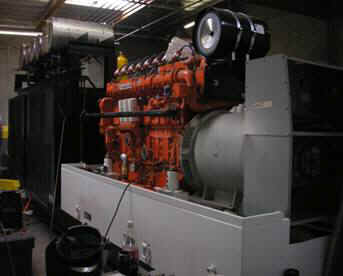
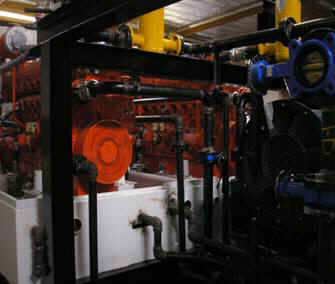
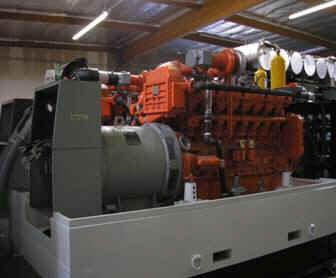
Our CHP Systems may be the best solution for your company's economic and environmental sustainability as we "upgrade" natural gas to clean power with our clean power generation solutions.
Our Emissions
Abatement solutions reduce Nitrogen
Oxides to "non-detect" which means our Trigeneration
energy systems can be installed and
operated in most EPA non-attainment regions!
_______________________________________________________
______________________________________________________
energy
system, through a Power
Purchase Agreement that guarantees
a minimum 10% reduction in our client's energy expenses.
(NOTE: Our
engineering
and EPC services may be provided by one of our affiliated
ENR Engineering/EPC companies - one of which is a Fortune Top 300 company.
To receive a preliminary no-obligation review of your energy, engineering or
project plans,
send an introductory email to us at the following email address:
About us:
We provide engineering and renewable energy project development services (some through affiliated companies) including;
Economic Feasibility Analysis
Feasibility Studies
Front End Engineering Design - FEED
Greenhouse Gas Emissions consulting
Interconnection Studies
Project Development
Project Management
Project Finance/Funding introduction to potential investors
Power Purchase Agreement consulting & PPA funding
Our work is performed on a strict adherence to "vendor-neutrality." We are client and project focused and seek to maximize our client's return on their investment while simultaneously minimizing their operational expenses and environmental exposure.
Engineering and related interim project development expenses may be at client's expense but will be refunded at the close of Power Purchase Agreement or other project financing. Some of our engineering and related EPC services may be provided by one of our top-ranked ENR Engineering/EPC affiliated companies.
______________________________________________________
History
of the
Brayton Cycle,
Carnot
Cycle, Cheng
Cycle,
Graz
Cycle, Kalina
Cycle, Organic Rankine Cycle,
Rankine Cycle
and
Waste Heat Recovery
What is the
Brayton Cycle?
Gas turbines operate on the principal of the Brayton Cycle, which is defined as a constant pressure cycle, with four basic operations which it accomplishes simultaneously and continuously for an uninterrupted flow of power.
Background
Information and History of Rudolph Diesel and Sadi Carnot
Rudolph Diesel was educated at the predecessor school to the Technical
University of Munich, Germany. In 1878, he was introduced to the work of Sadi
Carnot, who theorized that an engine could achieve much higher efficiency than
the steam engines of the day. Carnot envisioned a cycle in which a gas is
compressed, heated, allowed to expand, and then cooled. After the gas is cooled,
the cycle begins anew. Mechanical energy is used to compress the gas and thermal
energy to heat it. In turn, expansion of the gas yields mechanical energy, and
its cooling yields thermal energy. The net result is conversion of thermal
energy to mechanical energy.
Diesel sought to apply Carnot’s theory to the internal combustion engine. The efficiency of the Carnot Cycle increases with the compression ratio—the ratio of gas volume at full expansion to its volume at full compression. Nicklaus Otto invented an internal combustion engine in 1876 that was the predecessor to the modern gasoline engine. Otto’s engine mixed fuel and air before their introduction to the cylinder, and a flame or spark was used to ignite the fuel-air mixture at the appropriate time. However, air gets hotter as it is compressed, and if the compression ratio is too high, the heat of compression will ignite the fuel prematurely. The low compression ratios needed to prevent premature ignition of the fuel-air mixture limited the efficiency of the Otto engine.
Rudolph Diesel wanted to build an engine with the highest possible compression ratio. He introduced fuel only when combustion was desired and allowed the fuel to ignite on its own in the hot compressed air. Diesel’s engine achieved an efficiency higher than that of the Otto engine and much higher than that of the steam engine. It also eliminated the trouble-prone electric-spark ignition system. Diesel received a patent in 1893 and demonstrated a workable engine in 1897. Today, diesel engines are classified as “compression-ignition” engines, and Otto engines are classified as “spark-ignition” engines.
What is the
Carnot Cycle?
The Carnot Cycle has been described as being the most efficient thermal cycle possible, wherein there are no heat losses, and consisting of four reversible processes, two isothermal and two adiabatic. It has also been described as a cycle of expansion and compression of a reversible heat engine that does work with no loss of heat.
What is the Cheng
Cycle?
The Cheng Cycle is a highly flexible and efficient method of optimizing a cogeneration plant, and more specifically a combined cycle power plant, which also provides a high amount of flexibility in the power and thermal energy output.
For a Cheng Cycle to be implemented, a gas turbine and waste heat boiler or heat recovery steam generator (HRSG) is required. The gas turbine is updated to accept steam injection - the steam being "superheated steam" which is capable of handling up to 20% of the exhaust flow from the gas turbine. The saturated steam as well as the superheated steam, is generated from the waste heat boiler or heat recovery steam generator.
When
the Cheng Cycle is in 100% power mode, all of the steam that is produced by the
"waste heat" from the gas turbine, is "recycled" through the gas turbine.
In cogeneration plants, the Cheng Cycle system is set-up so that steam may be used for process
application and-or recycled back to the gas turbine. A duct burner is placed between the gas turbine and the
waste heat boiler
or the heat
recovery steam generator
(HRSG) which increases the total amount of steam output generated by the plant.
What is the Graz Cycle?
The Graz Cycle is the only thermodynamic combustion cycle that allows for the retention and capture of carbon dioxide emissions from the combustion of fossil fuels.
The Graz Cycle burns fossil fuel along with pure oxygen thereby enabling for the cost-effective separation of the carbon dioxide emissions from the combustion process through condensation. The additional expense for supplying the oxygen for the combustion process - and requirements for an air separation unit, are compensated, in part, through the increase in cycle efficiencies that exceed 65%. The combined efficiency of the Graz Cycle equals of exceeds the thermodynamic performance of other serious contenders in Carbon Capture and Sequestration (CCS).
The Graz Cycle is the thermodynamic cycle that provides for a "zero emission power plant" which also has the highest available efficiencies using gas turbines. The Graz Cycle has also been heralded as a "zero emission" power plant.
In practice, net electrical cycle efficiencies for Graz Cycle power plants have exceeded 65% - which is far higher than typical of state-of-the-art combined cycle plants.
According to the DOE web site, the Graz Cycle consists of a high temperature Brayton cycle and a low temperature Rankine cycle with a Heat Recovery Steam Generator. The Graz Cycle is an oxy-fuel power cycle with the capability of retaining all the combustion generated CO2 for further use. Its cycle configuration aims at highest efficiency by reducing the heat extraction in the condenser to a minimum. A thermodynamic investigation of the Graz Cycle fired with natural gas (CH4) shows a net efficiency of 52.5%, if the efforts for oxygen supply and CO2 compression to liquefaction are considered. If synthesis gas can be used from an external synthesis gas plant at 500°C, efficiencies can rise up to 56%. Studies indicate that further efficiency improvements and simplification of the cycle are possible.
What is the
Kalina Cycle?
The Kalina Cycle was invented by Alexander Kalina, a Russian engineer, which he first demonstrated in the mid 1960's.
The Kalina Cycle is different from the Rankine Cycle in that the Kalina Cycle uses a water and ammonia solution in low temperature Waste Heat Recovery applications, such as geothermal power plants. This increases the thermodynamic efficiency and power output.
While few Kalina Cycle plants have been built to date, reports of the technology's efficiency may exceed that of the Organic Rankine Cycle and represent an exciting development in Waste Heat Recovery.
What is the
Organic Rankine Cycle?
A Rankine Cycle is a closed circuit steam cycle. (Also - see Rankine Cycle).
An Organic Rankine Cycle uses a heated chemical instead of steam as found in the Rankine Cycle.
Chemicals
used in the Organic
Rankine Cycle include freon, butane, propane, ammonia, and the new environmentally-friendly"
refrigerants.
Why use a chemical refrigerant?
A refrigerant boils at a temperature below the temperature of frozen ice. Solar
heat, for example, of only 150 degrees Fahrenheit from a typical rooftop solar
hot water heater, will furiously boil a refrigerant. The resulting high-pressure
refrigerant vapor is then piped to an organic Rankine Cycle
engine.
Why is it called "organic"?
"Organic" is a term used in chemistry to describe a class of chemicals
that includes Freon and most of the other common refrigerants.
What is the
Rankine Cycle?
The Rankine Cycle is a thermodynamic cycle used to generate electricity in many power stations, and is the real-world approach to the Carnot Cycle. Superheated steam is generated in a boiler, and then expanded in a steam turbine. The steam turbine drives a generator, to convert the work into electricity. The remaining steam is then condensed and recycled as feed-water to the boiler. A disadvantage of using the water-steam mixture is that superheated steam has to be used, otherwise the moisture content after expansion might be too high, which would erode the turbine blades.
What is Stack Gas?
Stack gas also known as flue gas and "wasted heat," is the heat, passes through or "escapes" through a chimney or smokestack. Typically, stack gas begins with the combustion in a boiler of a fossil fuel, such as natural gas, diesel or coal.
What is Waste Heat
Recovery?
There are more than 500,000 smokestacks in the U.S. that are "wasting" heat, an untapped resource that can be converted to energy with Waste Heat Recovery technologies.
About 10% of these 500,000 smokestacks represent about 75% of the available wasted heat which has a stack gas exit temperature above 500 degrees F. which could generate approximately 50,000 megawatts of electricity annually and an annual market of over $75 billion in gross revenues before tax incentives and greenhouse gas emissions credits.
Waste Heat Recovery technologies represent the least cost solution which provides the greatest return on investment, than any other possible green energy technology or "carbon free energy" opportunity!
Typical Waste Heat Recovery Installation
In some cogeneration and trigeneration designs, the exhaust gases can be used to activate a thermal wheel or a desiccant dehumidifier. Thermal wheels use the exhaust gas to heat a wheel with a medium that absorbs the heat and then transfers the heat when the wheel is rotated into the incoming airflow.
A professional engineer should be involved in designing and sizing of the Waste Heat Recovery section. For a proper and economical operation, the design of the heat recovery section involves consideration of many related factors, such as the thermal capacity of the exhaust gases, the exhaust flow rate, the sizing and type of heat exchanger, and the desired parameters over a various range of operating conditions of the cogeneration or trigeneration system — all of which need to be considered for proper and economical operation.
Many processes, especially in industrial applications, produce large amounts of excess heat – i.e., heat beyond what can be efficiently used in the process. Waste Heat Recovery methods attempt to extract some of the energy as work that otherwise would be wasted.
Typical methods of recovering heat in industrial applications include direct heat recovery to the process itself, recuperators, regenerators, and waste heat boilers. In many applications – especially those with low-temperature waste heat streams, such as automotive applications – the economic benefits of waste heat recovery do not justify the cost of the recovery systems. Innovative, affordable methods that are highly efficient, applicable to low-temperature streams, and/or suitable for use with corrosive or “dirty” wastes could expand the number of viable applications of waste heat recovery, as well as improve the performance of existing applications. Our focus is on the development of innovative Waste Heat Recovery processes and techniques that are (1) more efficient than conventional methods, yet still cost-effective; and (2) applicable to waste streams from which heat cannot be recovered easily with conventional methods.
Turning to cooling, air conditioning systems consume approximately 10% of the energy used in U.S. buildings and are key contributors to peak demand. Consequently, improving the energy efficiency of air conditioning systems would substantially reduce overall energy consumption and enhance grid reliability. For example, compressors require cooling to dissipate the heat produced during compression and could benefit from improved surface heat transfer – innovative designs could increase the available heat-transfer area or materials enhancement could increase the heat flux between the hot and cool sides of a heat exchanger. Similarly, a reduction in the requirement for condenser cooling could provide significant energy savings if more-efficient, cost-effective technologies were developed.
This is where we believe waste heat recovery integrated with our Solar Trigeneration energy systems represents a unique opportunity for commercial and industrial clients.
Industrial Waste Heat Recovery
Waste Heat Recovery from exit gases can significantly increase the energy efficiency of industrial processes. Energy can be recovered from flue and stack gases, vent gases, and combustion gases at a variety of temperatures at large-scale industrial plants (chemical plants, petroleum refineries, biorefineries, pulp and paper mills, etc.).
______________________________________________________
Is an Absorption Chiller or a Geothermal
Heat Pump the Best Choice for You?
You have a combined
heat and power CHP) unit and cannot use all of the available heat, or
if you are considering a new CHP plant
Waste heat is
available
A low-cost source
of fuels is available
Your boiler
efficiency is low due to a poor load factor
Your site has an
electrical load limit that will be expensive to upgrade
Your site needs
more cooling, but has an electrical load limitation that is expensive
to overcome, and you have an adequate supply of heat.
In
short, absorption cooling may fit when a source of free or low-cost heat
is available, or if objections exist to using conventional refrigeration.
Essentially, the low-cost heat source displaces higher-cost electricity in
a conventional chiller.
In
Practice
In a plant where low-pressure steam is currently being vented to the
atmosphere, a mechanical chiller with a COP of 4.0 is used 4,000 hours a
year to produce an average 300 tons of refrigeration. The plant's cost of
electricity is $0.05 a kilowatt-hour.
An absorption unit requiring 5,400 lbs/hr of 15-psig steam could replace
the mechanical chiller, providing annual electrical cost savings of:
Annual
Savings = 300 tons x (12,000 Btu/ton / 4.0) x 4,000 hrs/yr x $0.05/kWh x
kWh/3,413 Btu = $52,740
Actions You Can Take
Determine
the cost-effectiveness of displacing a portion of your cooling load with a
waste steam absorption chiller by taking the following steps:
Conduct a plant
survey to identify sources and availability of waste steam
Determine cooling
load requirements and the cost of meeting those requirements with
existing mechanical chillers or new installations
Obtain installed
cost quotes for a waste steam absorption chiller
Conduct a life cycle cost analysis to determine if the waste steam absorption chiller meets your company's cost-effectiveness criteria.
The basic cooling cycle is the same for the absorption and electric chillers. Both systems use a low-temperature liquid refrigerant that absorbs heat from the water to be cooled and converts to a vapor phase (in the evaporator section). The refrigerant vapors are then compressed to a higher pressure (by a compressor or a generator), converted back into a liquid by rejecting heat to the external surroundings (in the condenser section), and then expanded to a low- pressure mixture of liquid and vapor (in the expander section) that goes back to the evaporator section and the cycle is repeated.
The basic difference between the electric chillers and absorption chillers is that an electric chiller uses an electric motor for operating a compressor used for raising the pressure of refrigerant vapors and an absorption chiller uses heat for compressing refrigerant vapors to a high-pressure. The rejected heat from the power-generation equipment (e.g. turbines, microturbines, and engines) may be used with an absorption chiller to provide the cooling in a CHP system.
The basic absorption cycle employs two fluids, the absorbate or refrigerant, and the absorbent. The most commonly fluids are water as the refrigerant and lithium bromide as the absorbent. These fluids are separated and recombined in the absorption cycle. In the absorption cycle the low-pressure refrigerant vapor is absorbed into the absorbent releasing a large amount of heat. The liquid refrigerant/absorbent solution is pumped to a high-operating pressure generator using significantly less electricity than that for compressing the refrigerant for an electric chiller. Heat is added at the high-pressure generator from a gas burner, steam, hot water or hot gases. The added heat causes the refrigerant to desorb from the absorbent and vaporize. The vapors flow to a condenser, where heat is rejected and condense to a high-pressure liquid. The liquid is then throttled though an expansion valve to the lower pressure in the evaporator where it evaporates by absorbing heat and provides useful cooling. The remaining liquid absorbent, in the generator passes through a valve, where its pressure is reduced, and then is recombined with the low-pressure refrigerant vapors returning from the evaporator so the cycle can be repeated.
Absorption chillers are used to generate cold water (44°F) that is circulated to air handlers in the distribution system for air conditioning.
"Indirect-fired" absorption chillers use steam, hot water or hot gases steam from a boiler, turbine or engine generator, or fuel cell as their primary power input. Theses chillers can be well suited for integration into a CHP system for buildings by utilizing the rejected heat from the electric generation process, thereby providing high operating efficiencies through use of otherwise wasted energy.
"Direct-fired" systems contain natural gas burners; rejected heat from these chillers can be used to regenerate desiccant dehumidifiers or provide hot water.
Commercially absorption chillers can be single-effect or multiple-effect. The above schematic refers to a single-effect absorption chiller. Multiple-effect absorption chillers are more efficient and discussed below.
Multiple-Effect Absorption Chillers
In a single-effect absorption chiller, the heat released during the chemical process of absorbing refrigerant vapor into the liquid stream, rich in absorbent, is rejected to the environment. In a multiple-effect absorption chiller, some of this energy is used as the driving force to generate more refrigerant vapor. The more vapor generated per unit of heat or fuel input, the greater the cooling capacity and the higher the overall operating efficiency.
A double-effect chiller uses two generators paired with a single condenser, absorber, and evaporator. It requires a higher temperature heat input to operate and therefore they are limited in the type of electrical generation equipment they can be paired with when used in a CHP System.
Triple-effect chillers can achieve even higher efficiencies than the double-effect chillers. These chillers require still higher elevated operating temperatures that can limit choices in materials and refrigerant/absorbent pairs. Triple-effect chillers are under development by manufacturers working in cooperation with the U.S. Department of Energy.
____________________________________________________
Solar
Trigeneration sm
www.SolarTrigeneration.com
We install our Solar
Trigenerationsm
Energy Systems, for qualified commercial businesses, as well
as cities, schools and government facilities with our Zero Up-front Cost
program.
For some customers - based on their present location, utility company and electric rate - we are able to reduce their electric rate by 10%. Even more for other customers. Solar Trigenerationsm Energy System!
We provide the answers to your questions about solar power and energy!
Does your; business, city, school, or electric utility want a more sustainable solar power and energy solution?
Are you interested in transforming your facility, campus or building(s) to "Net Zero Energy"™ buildings?
Does your city or school have a problem with rising electricity and energy expenses, but not have the financial resources to provide the necessary updates and upgrades to make your buildings more efficient?
Maybe you have already decided to go solar, but you have a lot of questions, and don't know where to start. Call us, we have the answers to your solar questions.
What is the optimum solar solution? There are hundreds of companies in the solar power and energy industry..... Who do you call to help you with these questions to help you make the right decisions?
There's still more questions, that you may not have thought about..... which solar technology do you go with, and what is the return on investment?
Are there any solar rebates, refunds, tax credits or other incentives available?
What about investors that might be interested in owning/operating and maintaining our solar energy system under a Power Purchase Agreement?
You have numerous questions and need the answers to help in the decision-making process regarding the solar power and energy system you want to install. These decisions will have a long-lasting impact as the solar energy system that you install at your business or facility will probably be generating clean power for the next 40 to 50 years, if not longer! So, the decisions that you need to make now regarding your solar energy system will be a decision that will be either a long-term asset or a liability, depending on the equipment you select and who you choose to install it.
We can help cities, schools and commercial (and large residential) customers make the switch to solar!
And now, with our no up-front cost for our Solar Trigenerationsm Energy System, we can also transform your building(s) to a "Net Zero Energy Building"™ and many times, actually REDUCE your present energy expenses by 10%, and possibly more!
Examples of buildings/facilities where our Solar Trigenerationsm Energy Systems would benefit, include; universities, churches, data centers, shopping centers, schools, radio/television stations, food processing, warehouses, new real estate developments and subdivisions, and electric utilities - practically any commercial facility can be upgraded to one of our "pollution free power" systems featuring one of our solar energy systems, including our Solar Trigenerationsm system!
Call or email us, we can provide these answers. We are focused on providing the optimum solar energy systems for our clients. This begins with an initial review of your past 12 months energy/electrical bills. The next step would include a site visit which may include a Demand Side Management study and/or a Solar Feasibility Study which determines the optimum solar energy system for your facility or location. Once the optimum solar solution(s) are determined, we then have a blueprint to proceed that could include our installing one of our Solar Cogeneration or Solar Trigeneration energy systems. Or for a city, real estate development or subdivision, or an electric utility, one of our utility scale power plants which might be a Concentrating Photovoltaic, Concentrating Solar Power or High Concentration Photovoltaic power plants.
What is "Net Zero Energy?"
Net Zero Energy - when applied to a home or commercial building, simply means that the home or buildings generates as much power and energy as they consume, when measured on a monthly or annual basis, and with an onsite, renewable energy system, such as our Solar Trigeneration Energy System.
What is a Net Zero Energy Buildingsm?
A Net Zero Energy Building produces as much energy as it uses over the course of a year. Net Zero Energy Buildings are very energy efficient. The remaining low energy needs are typically met with on-site renewable energy.
First of all, understand that there is no such thing as a "zero energy building!" EVERY building uses energy, or you may as well be in a cave!
The important considerations are,
1. How efficient is the building?
2. How much energy does the building use, and how efficiently is it used?
3. How much "carbon free energy" or "pollution free power" is generated by the buildings' own onsite renewable energy system?
4. What are
the utility company's prices for the excess power generated and sent to the
grid?
(see: Net Energy Metering)
5. How difficult is it to interconnect the renewable energy system of the building with the utility company's powerlines/electric grid?
At the heart of a Net Zero Energy Building is the idea that any building can meet its energy requirements from low-cost, locally available, nonpolluting, renewable sources, like our Solar Trigeneration Energy Systems. Our Solar Trigeneration Energy Systems are the idea whose time has come, to make Net Zero Energy Buildings commonplace.
Solar Trigeneration Energy Systems Provide All of the Cooling, Heating & Power, for Any Size Building, with only the Energy of the Sun. Solar Trigeneration Energy Systems Provide Simultaneous Cooling, Heating & Power whether it is 12 Noon, or 12 Midnight, and can do so, WITHOUT Connection to the electric grid!
The
Diagram Below Shows How Our Solar
Trigeneration Energy System Works,
for Heating and Cooling a Building (next to the Solar Thermal Collectors, are the PV
Panels, that generate the Electricity).

Our
Solar
Trigenerationsm Energy
System
provides
"Cooling, Heating & Power" for your business,
or home with the free energy of the sun!
What is Net Energy Metering?
Net energy metering is used to measure a customer's total electric
consumption against that customer's total on-site electric generation. When
a customer's onsite generation of power exceeds the amount that they use, the customer's
solar energy system (or other renewable energy system) exports the extra electricity to the
grid. When the power requirements of the customer exceeds their onsite
generation of power, the customer imports the electricity they need from
electric grid. The customer pays the electric company for any extra power they
use over the amount they generate - OR - the customer receives a credit or
refund from the electric company if they exported more power to the grid, than
what they consumed.
Much focus is placed on energy efficiency as the most cost-effective way to reduce energy use in commercial buildings. However, consumption can be reduced only so much. There is a point at which the cost of adding efficiency measures is higher than that of using renewable energy such as thin film photovoltaics and other solar energy systems.
Aggressive energy efficiency strategies can reduce a building's energy consumption by 50% to 70%. Renewable energy technologies must be used to reach the goal of a net-zero energy building (NZEB).
Various supply-side renewable energy technologies are available for Net Zero Energy Buildings. Supply-side technologies, often called energy producers, collect natural energy and transform it into a useful form. Examples of these technologies include PV, solar hot water, wind, hydroelectric, and biofuels.
All renewable sources are favorable over conventional energy sources such as coal and natural gas; however, the U.S. Department of Energy recommends the following ranking for these options (the lower numbers are preferable):
|
Option Number |
NZEB Supply-Side Options |
Examples |
|---|---|---|
|
0 |
Reduce site energy use through low-energy building technologies |
Daylighting, high-efficiency heating, ventilation, and air-conditioning equipment (HVAC), natural ventilation, evaporative cooling |
|
On-Site Supply Options |
||
|
1 |
Use renewable energy sources available within the building's footprint |
PV, solar hot water, and wind located on the building |
|
2 |
Use renewable energy sources available at the site |
PV, solar hot water, low-impact hydroelectric, and wind located on-site, but not on the building |
|
Off-Site Supply Options |
||
|
3 |
Use renewable energy sources available off site to generate energy on site |
Biomass, wood pellets, ethanol, or biodiesel that can be imported from off site; waste streams from on-site processes that can be used on-site to generate electricity and heat |
|
4 |
Purchase off-site renewable energy sources |
Utility-based wind, PV, emissions credits, or other "green" purchasing options; hydroelectric is sometimes considered |
This hierarchy is weighted toward renewable technologies within the building
footprint and site. Rooftop PV and solar water heating are the most applicable
supply-side technologies for Net
Zero Energy Buildings. Other supply-side technologies such as parking
lot-based wind or solar energy
systems may be available.
The goal in developing the ranking was to encourage technologies that:
Minimize overall environmental impact by encouraging energy-efficient building designs and reducing transportation and conversion losses
Will be available over the lifetime of the building
Are widely available and have high replication potential for future Net Zero Energy Buildings.
______________________________________________________________________________________________________
Solar
Trigenerationsm
www.SolarTrigeneration.com
Now, Your
Business Can Have Our Solar Trigeneration™
Energy System, installed for No
Up-Front Costs!
Through an affiliated partner company, we are now installing our Solar Trigeneration™ Energy Systems, for qualified commercial businesses, nationwide, with Zero up-front costs.
Some customers may even see a decrease in their energy expenses by as much as 10% to 20% with our Zero up-front cost Solar Trigeneration™ Energy System!
To qualify for our no up-front cost Solar Trigeneration Energy Systems, businesses must:
Have a good credit rating
Agree to buy all of the energy generated from the Solar Trigeneration™ Energy System through a 20 year Power Purchase Agreement
Other conditions may apply, depending on location, state or utility company you are presently buying power from.
We expect ALL of our customers will be very happy knowing that the clean, green, renewable power they are using is:
More reliable than the electricity from the power company.
Saving the environment by reducing Greenhouse Gas Emissions and helping reverse Climate Change and Global Warming.
Generated from their own reliable Solar Power System on their roofs.
Saving Money! At today's published electric rates at Southern California Edison, TXU, Reliant and Centerpoint, most of our customers will also enjoy a SAVINGS on their present electric bills by as much as 10% from what they are now paying for their electricity from the electric utility.
Under warranty.
At the end of the Power Purchase Agreement, the Solar Trigeneration™ Energy System is then offered for sale to our customers, for $1.00. And then their energy savings really start to add up as the power and electricity generated from their Solar Trigeneration™ Energy System is free!
Solar
Trigenerationsm
is Here!
Solar Trigeneration Provides
Almost Any Building - with all of its
Cooling, Heating & Power Requirements. Solar
Trigenerationsm
is also the Greenest Way to
Cool, Heat and Power your Facility -
whether that's a Hospital, Data Center, Office Building or University
Campus
Commercial, Industrial & Utility Customers:
Reduce or COMPLETELY ELIMINATE
Your Electric Power, Natural Gas Expenses
and Greenhouse Gas
Emissions!
Stop
Paying High Utility Bills to the Electric and Natural Gas Companies!
Let us Show You How You
Can
"Cut the Cord" to the Electric Company!
Our
"Solar
Trigenerationsm" Power and Energy Systems
Generate Carbon Free Energy and
Pollution Free Power
Which is Sustainable, Clean, Renewable and Affordable
Solar Energy Systems provides cooler, cleaner, greener power and energy project development services. Our Solar Energy Systems are an environmentally-friendly and economically-superior choice to expensive natural gas and electricity. Additionally, our renewable energy technologies generate "green tags" or a Renewable Energy Credit.
We
provide
Solar
Power and Energy systems that we refer to as "EcoGeneration"
solutions that produce cooler, cleaner, greener power and energy for our
customers and our environment. Unlike most companies, we are equipment
supplier/vendor neutral. This means we help our clients select the best
equipment for their specific application. This approach provides our
customers with superior performance, decreased operating expenses and
increased return on investment.
Our company provides turn-key project solutions that include all or part
of the following:
Engineering and Economic Feasibility Studies
Project Design, Engineering & Permitting
Project Construction
Project Funding & Financing Options
Shared/Guaranteed Savings program with no capital requirements.
Project Commissioning
Operations & Maintenance
Green Tag/Renewable Energy Credit Application, and Marketing
Net
Zero Energy Buildingssm
www.NetZeroEnergyBuildings.com

The Sun
Powers the Audubon Nature Center's Solar
Trigeneration
System at Debs Park in Los Angeles. The Audubon Nature Center's
building is one of the world's first "Net
Zero Energy Buildings."
The Solar
Trigeneration
System Consists of a 10 Ton "Solar
Absorption Cooling"
System
Matched with a Solar
Electric
Power System and a Solar
Water Heating System
By: Monty Goodell, MBA
www.SolarTrigeneration.com
Los Angeles, California
There
is now a better, more efficient, “pollution
free power” and "carbon
free energy" solution for cooling, heating and powering
homes and commercial buildings where solar energy is available.
Solar Trigeneration is defined as the simultaneous generation of cooling, heating and power with only the free solar energy from the sun providing the "fuel".
Solar
Trigeneration is now
a reality at the Audubon
The Audubon Nature Center is totally powered by the sun’s energy and our Solar Trigeneration energy system!
The 5,300 square foot building operates entirely “grid-free” and without any electric connections to the electric grid, or natural gas connections – a truly sustainable power and energy solution.
Best
of all, the Audubon Center doesn’t rely on the over-burdened electric
grid or even natural gas. Therefore, the Audubon
Nature Center
NEVER receives an electric bill or
natural gas bill.... ever!
The
Audubon
Nature Center's 5,000 square foot
office and conference facility is powered by a Solar
Trigeneration
system that features a 25-kilowatt solar electric power system where the
energy is stored in a bank of batteries. The Center is cooled by a
10-ton solar
absorption cooling
system powered by an array of very efficient solar heat pipe vacuum tube
thermal collectors. The
collectors heat the water to temperatures of 200+ degree F stored in a
1,200 gallon insulated tank, another type of inexpensive battery. The Solar
Trigeneration
system at the Audubon not only provides the air-conditioning in the
summer but also heats the building in the winter, and provides the hot
water for the kitchen and bathrooms.
Absorption
chillers,
and cooling with solar energy with an absorption chiller are not new
technologies.
In fact, absorption chiller technology is over 70 years old.
The first refrigerators were powered by propane gas to run the
absorption chillers that used ammonia as a refrigerant.
Electricity and the electric compression chiller gained
popularity only because of the convenient “plug and play” appliance
and relatively cheap electric rates.
Electricity is no longer economically, or environmentally “cheap.”
History of Cogeneration and Trigeneration
Few people realize that the world's first commercial power plant, designed and built by Thomas Edison, was a cogeneration power plant that was first opened on Pearl Street, in Lower Manhattan, New York. That was in 1882! Edison not only generated, and sold electricity in the several blocks surrounding his "Pearl Street Station" but he also sold the hot water that was also generated from the cogeneration plant. The fuel Edison used for generating the electricity and hot water (cogeneration) came from "pulverized coal." The Pearl Street Station provided 110 volts of "direct current" power to 59 customers in lower Manhattan, around his Pearl Street laboratory.
Cogeneration is the simultaneous production of heat and power.
Trigeneration is the simultaneous production of cooling, heating and power.
Our company, in partnership with the Renewable Energy Institute and our affiliated partners, have perfected "Solar Cogeneration" and "Solar Trigeneration" which are the "heart" of our Net Zero Energy Buildings.
Unlike traditional cogeneration and trigeneration power plants that are fueled by natural gas - and Thomas Edison's cogeneration plant, which was fueled with pulverized coal, our Solar Cogeneration and Solar Trigeneration energy systems are fueled with the energy of the sun! And, while natural gas is a "cleaner" fuel, it still has its problems in that it is a limited resource and generates greenhouse gas emissions. Natural gas also have had extreme price swings and has a history of price volatility. Natural gas prices have gone from a high of $17.00/mmbtu to a recent low of under $3.00/mmbtu.
Regarding pulverized coal, yes, it's cheap in terms of the cost of generating electricity, but too many people forget about the "externalities" of pulverized coal that is not reflected in the "cheap" costs of generating electricity from pulverized coal. These costs not accounted for are the huge environmental cost relating to the use of pulverized coal. Pound for pound, pulverized coal and coal fired power plants generate more greenhouse gas emissions than any other fossil fuel. There are also the costs related to the health and safety issues of the miners that mine the coal. And, the costs to the environment in terms of the ever-increasing amounts of mercury that are "dumped" into the environment from coal fired power plants, is also not reflected in the "cheap" price of generating power from pulverized coal.
Unlike the problems inherently found with the use of fossil fuels, Solar Cogeneration and Solar Trigeneration have no such problems.
And talk about "cheap" costs of generating power and energy, there is nothing cheaper than free!!!!
The owners of the Audubon Nature Center never receive any monthly natural gas or electric bills!
And the owners of the Audubon Nature Center will never have to account for their greenhouse gas emissions, or comply with the ever-increasing regulations related to greenhouse gas emissions and the pending Cap and Trade laws..... thanks to our Solar Trigeneration energy system!
Solar
Trigeneration
is an EcoGeneration
solution. EcoGeneration
refers to a power and energy system that uses the “natural” energy
or fuel that is available for a specific site or location. Such energy
or fuel includes, solar, wind, BioMethane,
geothermal, and ocean power, including ocean tidal and ocean thermal
energy conversion. For
example, in the desert areas of the
Today,
the cause of the summer peak electric demand, electric supply problems,
and black-outs, are the result of the energy crisis in
Greater
Demands on California’s Limited Electric Supply, Lack of New Electric
Power Supplies, and This Summer’s Heat Wave are Compounding the
Problem Leading to the “Perfect Electric
Storm”
Many
people will remember the movie “The Perfect Storm” from several
years ago, when several storms came together in the northeastern part of
the
The
most likely time of year for a black-out in
How
Do We Prevent the “Perfect Electric Storm” from Occurring
in California and Other Regions in the U.S.?
Another
major concern is how do we prevent the “Perfect Electric Storm” from
happening, like the Northeast Blackout several summers ago, especially
for people living in the desert?
Governor
Schwarzenegger’s “Million Solar Roofs” program and the passage of
the 2005 Federal Energy Act will be the foundation to create a “Perfect Solar
Storm” to trigger the Solar Economy throughout California.
With
the threat of California’s seniors and elderly dying from heat
exhaustion due to power outages, black-outs, rolling black-outs and the
rising costs of electricity and natural gas, combined with the
continuing impact of global warming, the perfect solution is to create a
Solar Revolution by cooling, heating and powering the desert with solar
energy and technologies like Solar
Cogeneration or Solar
Trigeneration.
For
more information about Solar
Energy Systems, such as Solar
Cogeneration or Solar
Trigeneration,
call/email the Renewable Energy Institute
The Audubon Center's new Solar Trigeneration
power and energy system
makes this building a "Net Zero Energy Building"
The Audubon's Roof showing
the Solar
Thermal Collectors, part of the
Solar Trigeneration
power and energy system
The heart of the Audubon's Solar Trigeneration
power and energy system
provides "free heating, cooling and domestic hot water," a
"net zero energy
building."
The hot water from the Solar Thermal Collectors
on the roof of the Audubon is
pumped here for producing the building's
heating, cooling and domestic hot water.
Hot water is stored in the tank on the left for overnight.
_______________________________________________________
What is "Decentralized Energy"?
Decentralized Energy is the opposite of "centralized energy." Decentralized Energy energy generates the power and energy that a residential, commercial or industrial customer needs, onsite. Examples of decentralized energy production are solar energy systems and solar trigeneration energy systems.
Today's electric utility industry was "born" in the 1930's, when fossil fuel prices were cheap, and the cost of wheeling the electricity via transmission power lines, was also cheap. "Central" power plants could be located hundreds of miles from the load centers, or cities, where the electricity was needed. These extreme inefficiencies and cheap fossil fuel prices have added a considerable economic and environmental burden to the consumers and the planet.
Centralized energy is found in the form of electric utility companies that generate power from "central" power plants. Central power plants are highly inefficient, averaging only 33% net system efficiency. This means that the power coming to your home or business - including the line losses and transmission inefficiencies of moving the power - has lost 75% to as much as 80% energy it started with at the "central" power plant. These losses and inefficiencies translate into significantly increased energy expenses by the residential and commercial consumers.
Decentralized Energy
is the Best Way to Generate Clean and Green Energy!
How we make and distribute electricity is changing!
The electric power generation, transmission and distribution system (the electric "grid") is changing and evolving from the electric grid of the 19th and 20th centuries, which was inefficient, highly-polluting, very expensive and “dumb.”
The "old" way of generating and distributing
energy resembles this slide:
The electric grid of the 21st century (see slide below)
will be
Decentralized, Smart, Efficient and provide "carbon
free energy" and “pollution
free power” to customers who remain on the
electric grid. The electric grid of the future will be comprised of
both Onsite Power
Generation plants and "utility
scale power plants" that are fueled/powered with Biomass
Gasification, Biomethane, Concentrating
Solar Power, B100 Biodiesel, Distributed
PV, EcoGeneration Systems, Geothermal
Power Plants, Synthesis
Gas, Rooftop PV, Solar
Cogeneration, Solar Energy
Systems, Solar Power Parks, Solar
Trigeneration and Wind Power
Generation - located at Residential, Commercial, Industrial
and City/Municipal Locations.
Some customers will choose to dis-connect from the grid entirely. (Electric grid represented by the small light blue circles in the slide below.)
The transmission grid will be upgraded to a "Smart Grid" with green electrons now being wheeled via "High Voltage Direct Current."
Typical "central" power plants and the electric utility companies that own them will either be shut-down, closed or go out of business due to one or more of the following: failed business model, inordinate expenses related to central power plants that are inefficient, excessive pollution/emissions, high costs, continued reliance on the use of fossil fuels to generate energy, and the failure to provide efficient, carbon free energy and pollution free power.
Carbon free energy and pollution free power reduces our dependence on foreign oil and makes us Energy Independent while reducing and eliminating Greenhouse Gas Emissions.
* Some of the above information from the Department of Energy website with permission.
_______________________________________________________
Amazing
Solar Fact!
Did you know
that the silicon
contained in only one ton of sand,
and used in;
Distributed Solar Generation
and
produces as much electricity as burning 500,000 tons of coal?
_______________________________________________________
Carbon Dioxide Emissions
Since the year 1750
| ## |
| Total US CO2 since 1750 (cubic feet) |
______________________________________________________
Greenhouse Gas
Emissions
Photo courtesy of Alaska Image Library. U.S.
Fish and Wildlife Service
The
carbon clock tracks total carbon dioxide emissions in metric tons since 1750.
Since 1750, humans have emitted over 5 trillion pounds of carbon dioxide into
the atmosphere. Roughly half of this has ended up in the oceans where it is
beginning to damage the coral reefs. The other half is still in the atmosphere
and causing global warming. Each pound of CO2 takes up as much space as a 500
pound person.
The formula (which should be good for a year or two) is:
C(t) = 2.58 ×10¹² + 1240×t, where t is seconds since the start of 2007.
C is tonnes (metric tons) of carbon dioxide emissions.
2205 x C gives pounds of carbon dioxide emissions.
That comes to over 43 billion tons/year or over 86 trillion pounds/year.
Carbon dioxide (2) = 1 carbon atom with 2 oxygen atoms.
Carbon has relative weight 12 and Oxygen 16.
So it takes only 12 pounds of carbon to make 12+16+16 = 44 pounds of CO2.
Linked to the Loss of Polar Bears

______________________________________________________
Hubbert's Peak Oil Predictions Now Proving True?
Marion King Hubbert was a geologist and scientist who worked at Shell Oil company's research lab in Houston, Texas. Hubbert made several important contributions to geology, geophysics and petroleum geology. Hubbert is most recognized for the "Hubbert Curve" and " Hubbert Peak Theory" which is now referred to as " Peak Oil.
Hubbert's life work determined that the world has a finite amount of petroleum that can be produced. (Similarly, there is a finite amount of coal.) Many scientists and engineers believe we have reached Hubbert's "peak oil" limit. Hubbert's espouses that when 50% of domestic crude oil production has been reached, that there will be such significant upward demand on prices of the limited supplies of oil production, that the U.S. economy will experience severe economic, social, and political turmoil.
Hubbert's Peak Oil predictions have proven to be true and this is validated as the U.S. in the early 1970's produced about 60% of its' oil demand and imported 40%. That equation has flipped since then, because our domestic oil production has been on the decline since 1970, so now, due to our declining domestic oil production, we have to import 60% of our oil supplies, to meet our country's oil/energy demands.
The Next Oil Shock Could be the "mother" of All Oil Shocks
How severe our economic calamity and next "oil shock" will depend upon a number of factors, including when this occurs, as well as the following:
1. the dependence of the individual country upon its own crude oil production to meet its energy needs and to subsidize consumer imports;
2. the rate of relative decline in crude oil production;
3. the degree of difficulty encountered in replacing missing energy inputs;
4.
the degree to which our country had prepared in advance for this inevitable geological
and economic calamity.
Examples of past "oil shocks" and the economic and political
calamities that followed:
United States: Our peak crude oil production of domestic oil occurred in
1970; the first "oil shock" and oil crisis followed in 1973 with the
Arab/OPEC Oil Embargo.
Iran: Their peak crude oil production occurred in 1974; They had their islamic revolution 1979 that overturned government and replaced it with radical islam.
Soviet
Union: Their peak crude oil production
was in 1989; what happened next?
Their country disintegrated and the collapse of the Soviet Union followed in 1991.
Indonesia: Their peak crude oil production was in 1991; their financial
and government crisis followed in 1997.
Iraq: Iraq's crude oil production was in 1989; they then invaded Kuwait (for their oil) in 1991.
Using Mr. Hubbert's predictions, that beginning around 2000 we would see peak (global) oil production, then, if the country's not weaning themselves off of their oil addiction, and had not begun making the switch to renewable energy, that the negative economic and political calamities would soon follow, including ever-increasing prices of energy that is from fossil fuels.
Now is the time to begin weaning ourselves off of fossil fuels and making the transition to and increasing the use of renewable energy. If you don't believe in climate change, or global warming, GREAT! Join us in the switch to renewable energy and a fossil-free economy!
______________________________________________________
America's "Clear and Present Danger"
America
Has INCREASED its' Dependence on Foreign
Sources of Energy by 50% Since 1973.
America
is even more "addicted" to foreign oil today, than we were in 1973 -
1974 when OPEC, Saudi Arabia and other suppliers from the Middle-East
stopped selling us their fossil fuels, and created a significant blow to our
economy.
According to the CIA Fact Book, Every Day, the U.S.
PRODUCES: 7,460,000 bbls of oil
CONSUMES:
20,800,000 bbls of oil
This
Means that 65% of America's Energy Supplies are Now Imported from Suppliers
from Foreign Countries.
Simply put, about 65% of the gasoline in your car's gas tank, comes from a foreign country.
EVERY day, the U.S. must IMPORT over 13 million bbls of oil from foreign countries and foreign suppliers to meet demand.
At
$80/barrel of oil, this also means that $1,040,000,000.00 American Dollars leave
our country, EVERY DAY, to foreign countries/suppliers of our fossil fuels, to
pay for the energy we need.
That's
$1 Billion EVERY day leaving our economy, and going to support a foreign
country's economy.
Talk
about our foreign trade deficit..... nearly $400 Billion each year, leaves our
country to pay for our oil addiction and the energy we need. To be exact,
that's $379,600,000,000.00 American Dollars.
This is NOT acceptable.
America needs to quickly transition to Energy Independence.
Renewable Energy is the Only Way America Can Achieve Energy Independence.
Millions of new and sustainable American jobs would be created here at home, if we would end our addiction to foreign fossil fuels, and quickly transition to an economy based on renewable energy and renewable fuels, produced here in the U.S.A.
The good news is that today, America already has all of the Renewable Energy Resources and Renewable Energy Technologies needed to make American Energy Independence a reality.
According to Monty Goodell, Founder and Chairman of the Renewable Energy Institute, "our increased dependence and reliance on foreign energy supplies represents a Clear and Present Danger to our national security, our economy, and the lives and livelihood of every American. Energy - including the energy we use from imported fossil fuels, is the very "lifeblood" of the American economy as it is for every industrialized country. An economy dies without it's lifeblood of energy. This Clear and Present Danger we face is far more serious than the problems related to greenhouse gas emissions. And while greenhouse gas emissions are very serious issue, in the long-term, pales in comparison to America's vital national security interests and America's economic stability in the short term. For this reason alone, America needs to transition away from its addiction to foreign energy supplies. And America's abundant renewable energy resources such as the energy we receive from the sun, and renewable energy technologies such as concentrated solar power (CSP) plants - can supply 100% of America's power requirements with a concentrating solar power plant measuring 75 miles by 75 miles, located in the Southwest U.S. By generating America's power from concentrating solar power plants, America resolves its' short-term Clear and Present Danger as it relates to importing its energy from foreign countries, and the long-term problems relating to greenhouse gas emissions."
Continuing, Mr. Goodell states that "too many Americans have forgotten what happened to us in 1973, when the Arabs and OPEC brought the United States economy to a screeching halt during the OPEC Oil Embargo. This happened because they (mainly the country of Saudi Arabia) disagreed with our foreign policy and is the reason why they "turned off the tap" of our need for their oil supplies. When Saudi Arabia and OPEC stopped the vital flow of oil to our country in 1973, they caused an "oil shock" that severely and negatively impacted our economy.
Mr. Goodell's question for us to ponder is, "do these countries who sell us 60% of our daily energy requirements, like us and our foreign policy, or might they leverage our addiction to their fossil fuels, and turn off the tap to make us adjust or revise our foreign policy?? Like any addict, America's foreign policy may be held hostage to its addiction, and in this case, our addiction to foreign oil, may over-ride our national interests."
Have
American's forgotten the gas shortages and long lines at
their gas stations to get
gas during the Arab Oil Embargo of 1973?
"Apparently so." Mr. Goodell states that "in 1973, America was 'addicted' and 'over the barrel' of foreign oil to the amount of 40%. Forty percent of our energy 'needs' in 1973 came from countries - many of which didn't like us then, and I'm afraid, many of them still don't. The difference between 1973 and today - is that today we receive 50% MORE foreign oil now than we did in 1973. And now we know about the problems relating to greenhouse gas emissions that we didn't know then. America needs to change course, and change course now, in terms of its' energy supplies and how we keep America's economy strong, without the threat of being held hostage to a middle-east tyrant or regime, that could once again, turn on us, and turn off our supply of foreign oil."
Remember ????

"Sadly, most Americans have forgotten the long lines of people waiting in their cars
- lined up and waiting
for gasoline at their nearby gas station, with lines that were many blocks
long. And, after waiting 4-5 hours, many even waiting overnight in many places, to
finally take their turn to fill up their car with gasoline, only to find that
the gas station
had run out of gas."
"Let me Repeat.... That was 1973 when we imported 40% of our daily energy requirements in the form of crude oil from overseas, and from foreign countries - and many of these from countries that don't like us.
Today, over 35 years later, America has yet to learn the lesson. We cannot continue our reliance on energy from foreign countries that supply us with 60% of the crude oil that our refineries use as a feedstock for producing gasoline and diesel fuel for our cars and trucks comes from overseas.
America is "over the barrel" and it's not our barrel, but the barrels of oil that we are addicted by and owned by other countries. Why have we not learned the lessons we needed to learn in 1973 when we were cut-off from the vital energy supplies we need?
Countries like China, are growing rapidly, and have an insatiable need for crude oil. China, with their booming economy, is increasingly growing in its clout and control over international supplies of crude oil - whether they do this through their ability to buy as much oil as they need on a daily basis, or whether they simply but American drilling rigs, technology, and explore and produce oil and gas from their own fields. China, is buying large amounts of oil for their country, and causing upward pricing on declining supplies. What happens if Russia, with all of their oil and natural gas, along with China and Venezuela, with or without the help of OPEC, decided to NOT sell oil to us????
To be sure, greenhouse gas emissions are a problem, and to some, greenhouse gas emissions are also a Clear and Present Danger, but not to the extent that it presents an imminent Clear and Present Danger.
America's reliance for 60% of our energy "needs" coming from foreign suppliers is un-acceptable.
The "driver" to get America to begin reducing and eliminating fossil fuel use should be our nation's national security and the welfare and safety of its citizens. And this can all begin with developing and investing in our own renewable energy resources and renewable energy technologies, let's start by putting solar on every rooftop that has a clear and unobstructed view of the Southern sky. See www.RooftopPV.com or www.DistributedPV.com for more information. Let's create incentives begin with adopting a national "Feed In Tariff" as Germany did in 1990.
We simply do NOT have the luxury of time on our hands. We need to end our
dependence and reliance on foreign fossil fuels, especially from countries that
don't like us! We need to rapidly begin expanding renewable energy
resources and renewable
energy technologies from our vast and abundant renewable energy resources,
such as; solar, solar energy
systems, solar cogeneration,
solar trigeneration,
"solar on every roof," along with; Biomass
Gasification, B100 Biodiesel, Biomethane,
E100
Ethanol (from cellulosic, agricultural waste, sugar cane, etc., and NOT from
corn), Geothermal Power Plants,
Natural Wastewater Treatment,
Synthesis Gas, Waste
To Energy, Waste To Fuel and Wind
Power Generation where it makes economic and environmental sense."

For more information, call or email:
![]()
______________________________________________________
Are you doing your part to prevent Climate Change and End America's Reliance on Foreign Energy?
Our following EcoGeneration
technologies,
including our
Biomethane, B100
Biodiesel and Synthesis Gas Fuels
Generated from our "Waste to Fuel"
technologies are Carbon Free Energy
and Pollution Free Power
solutions that will:
* forever change the way energy is generated and used.
* eliminate or greatly reduce our customer's electric demand charges and electric expenses.
* slow, stop and eventually reverse climate change by reducing and then
eliminating anthropogenic greenhouse
gas emissions - of which carbon
dioxide emissions makes up 80% of all greenhouse
gas emissions.
* reduce and eventually eliminate the use of coal and other fossil fuels.
*
reduce the need for inefficient and expensive central power plants owned by
utility companies.
* promote energy independence.
* end America's dependence on oil from OPEC and other countries in the Middle-East, Venezuela and end our need for importing natural gas from Russia.
Anaerobic Digester
www.AnaerobicDigester.com
Anaerobic Digesters
www.AnaerobicDigesters.com
B100 Biodiesel
www.B100Biodiesel.com
Biomass
Gasification
www.BiomassGasification.com
Biomethane
www.Biomethane.com
Carbon
Dioxide Emissions
www.CarbonDioxideEmissions.com
Carbon Emissions
www.CarbonEmissions.com
Carbon Free Energy
www.CarbonFreeEnergy.com
Clean Power Generation
www.CleanPowerGeneration.com
Cogeneration
www.Cogeneration.net
Concentrating
Solar Power
www.ConcentratingSolarPower.com
Distributed
PV
www.DistributedPV.com
Distributed
Solar Generation
www.DistributedSolarGeneration.com
EcoGeneration
www.EcoGeneration.com
Greenhouse Gas Emissions
www.GreenhouseGasEmissions.com
Marine
Cloud Whitening
www.MarineCloudWhitening.com
Net
Zero Energy
www.NetZeroEnergy.com
Pollution
Free Power
www.PollutionFreePower.com
Rooftop
PV
www.RooftopPV.com
Solar Energy Systems
www.SolarEnergySystems.net
Solar Power Parks
www.SolarPowerParks.com
Solar Cogeneration
www.SolarCogeneration.com
Solar Trigeneration
www.SolarTrigeneration.com
Synthesis Gas
www.SynthesisGas.com
Trigeneration
www.Trigeneration.com
Waste Heat Recovery
www.WasteHeatRecovery.com
Waste to Energy
www.WasteToEnergy.net
Waste
To Fuel
www.WasteToFuel.com
_______________________________________________________
We support the Renewable Energy Institute by donating a portion of our profits to the Renewable Energy Institute in their efforts to reduce fossil fuel use through renewable energy and their goals to end fossil fuel pollution by reducing/eliminating Carbon Emissions, Carbon Dioxide Emissions and Greenhouse Gas Emissions.
The Renewable Energy Institute is "Changing The Way The World Makes and Uses Energy by Providing Research & Development, Funding and Resources That Creates Sustainable Energy via 'Carbon Free Energy' and 'Pollution Free Power' Through Expanding the use of Renewable Energy Technologies."

![]()
![]()
www.RenewableEnergyInstitute.org
The information contained on this site is
copyright protected and
cannot be
reproduced in any form or manner without our consent.
Absorption Chillers
www.AbsorptionChillers.com
![]()
Renewable Energy Institute
Copyright
© 2000
All Rights Reserved